


| Quantity | Price |
|---|---|
| 1 - 4 | €174.99 |
| 5 - 10 | €169.99 |
| 11 - 20 | €164.99 |
| 21 - 50 | €154.99 |
| 51 - 100 | €144.99 |
| 101 - 200 | €134.99 |
| 201 + | €124.99 |
Ligustica Bee Colony Deutsch Normalmaß (DN)

| Quantity | Price |
|---|---|
| 1 - 4 | €169.99 |
| 5 - 10 | €164.99 |
| 11 - 20 | €159.99 |
| 21 - 50 | €149.99 |
| 51 - 100 | €139.99 |
| 101 - 200 | €129.99 |
| 201 + | €119.99 |
Buckfast Nucleus Colony Deutsch Normalmaß (DN)

| Quantity | Price |
|---|---|
| 1 - 4 | €169.99 |
| 5 - 10 | €164.99 |
| 11 - 20 | €159.99 |
| 21 - 50 | €149.99 |
| 51 - 100 | €139.99 |
| 101 - 200 | €129.99 |
| 201 + | €119.99 |
Carnica Nucleus Colony Deutsch Normalmaß (DN)


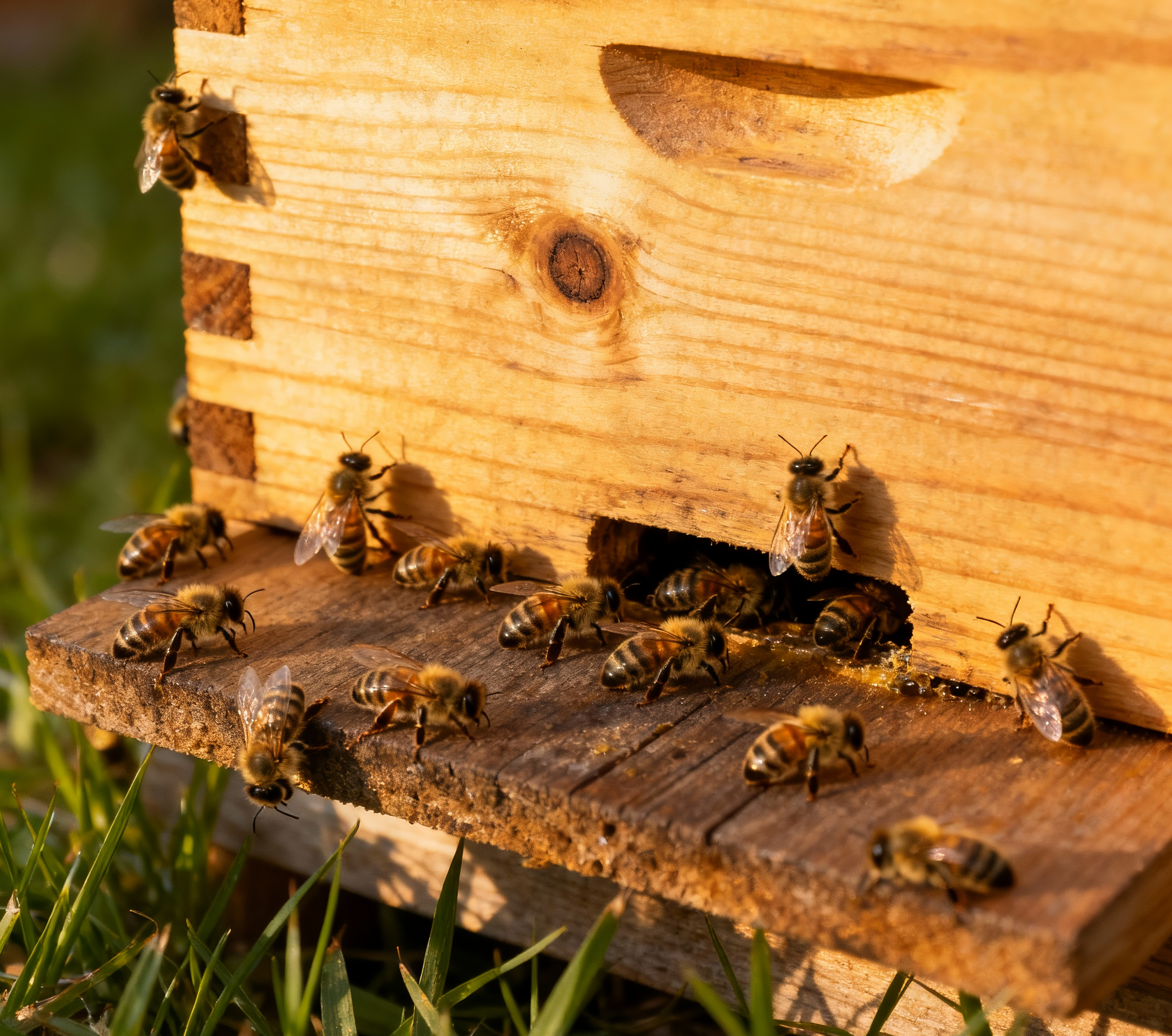


Buy DN nucs – colony composition and quality standard
What makes a good DN nucleus colony is not the number of bees alone, but the interplay of brood, food, a frame to draw out and the queen. A nucleus colony containing only bees and a queen, but no stable brood nest and no food reserve, will stall in the first few weeks – especially during spells of bad weather or nectar dearths in spring.
At Bienenzucht-Profi the standard is clearly defined: 5 frames with 3 brood frames as the core of the colony, 1 food frame as a safety net and 1 frame to draw out, which gives the colony room to grow straight away. The queen is mated and laying – she was checked for laying ability before shipping. This gives you a colony that grows predictably from day one: drawing out comb, adjusting space, keeping an eye on food stores.
There is another point that many buyers appreciate: a health certificate is available. Especially if you are adding a nucleus colony to existing stock, the documented health status gives you extra peace of mind and settles any questions from the vet.

Bee breeds on DN – which genetics suit your management method?
A bee colony on the Deutschnormalmaß is independent of breed – you can work with any common bee breed on DN. Which breed is right depends less on the frame size than on your management method, your location and your goals. Even so, there are some interesting connections when it comes to combining breed and DN.
Carnica and DN are historically closely linked. When Carnica became established in the German-speaking world, DN was already the predominant size. Many of the established Carnica breeding programmes – from the Celle line and Kirchhain to the Bavarian mating stations – are geared towards DN apiaries. If you keep Carnica on DN, you benefit from this long-established infrastructure: association work, access to mating stations and the exchange of experience are often rooted directly in the DN context.
Buckfast on DN is becoming increasingly popular. Beekeepers who want to switch from Carnica to Buckfast do not have to change their hive system – they swap the genetics, not the equipment. This makes getting started in Buckfast breeding on DN particularly easy.
The Dark Bee (Apis mellifera mellifera) on DN has a special historical justification: the Deutschnormalmaß was the size on which the Dark Bee was originally kept in Germany, before Carnica and other breeds came to dominate. For conservation breeding projects and beekeepers who want to work with the native bee, the Dark Bee on DN is a return to the roots.
Ligustica on DN is aimed at beekeepers who rely on rapid colony build-up and high brood activity. The Ligustica bee builds up reliably on DN and makes efficient use of the available brood space – especially in regions with a good early and summer nectar flow.

Buy DN nucs – regionally in Bavaria, Hesse and nationwide
Many beekeepers search for "buy DN nucs locally" because they want short distances and direct contacts. In practice, however, what matters most is that delivery and scheduling suit the season and that the nucleus colony has been properly prepared. Bienenzucht-Profi has apiaries in several German federal states and also has its office and warehouse in Hesse, close to the border with Bavaria, which makes it a genuinely regional supplier for many beekeepers – and at the same time we deliver nationwide by certified express shipping.
DN is most widespread in central and southern Germany. In Bavaria – around Munich, Nuremberg, Augsburg and Regensburg – the Deutschnormalmaß has a decades-long tradition and is the standard size in many associations. In Hesse and Rhineland-Palatinate (Frankfurt, Wiesbaden, Mainz, Kassel), DN is also firmly established and used by a broad community of beekeepers.
In North Rhine-Westphalia – Germany's most populous beekeeping region – many beekeepers work with DN, particularly in the associations around Düsseldorf, Cologne, Dortmund and Münster. In Baden-Württemberg (Stuttgart, Freiburg, Karlsruhe), DN coexists with Zander, and demand for high-quality DN nucleus colonies is stable. We also deliver reliably to Saxony (Dresden, Leipzig), Thuringia (Erfurt), Lower Saxony (Hanover, Braunschweig) and all other federal states.
That is precisely why the decisive question is not "is there DN somewhere?" but "has the DN colony been properly prepared and can it be delivered on schedule?" And we remain available as a specialist business for any questions after your purchase – an advantage you do not get with a private purchase.
Buy bees on DN in Germany and Austria
The Deutschnormalmaß is not only at home in Germany but is also used by many beekeepers in Austria – DN has a long tradition in Styria, Carinthia and Upper Austria in particular. If you want to buy bees on DN and order online, you will above all be looking for high quality standards for the bees, reliable live-animal logistics and a predictable delivery date.
Bienenzucht-Profi works with certified express shipping and packaging specifically designed for transporting bees. The colony arrives calm and free of stress. All our bee colonies are dispatched in the evening and reach you the very next day. This allows you to plan your hiving day exactly and prepare your hive in good time. You will be informed of the arrival day around 4–7 days before dispatch.
In addition to the breeds Carnica, Buckfast, Ligustica and Dark Bee, various mating options are also available for our DN colonies: mated at a mating station, mated at a mating station with certificate or island mated. This lets you choose between practical standard colonies and more highly selected variants with defined genetics – on the same DN size you are used to.
Buying DN bees – size and size variants, what you need to look out for
One point that is often underestimated when buying DN bees: unlike some other frame formats, the Deutschnormalmaß comes in several variants that look similar on the outside but differ at the millimetre level. Not all DN is the same – and if hive and frames do not match exactly, problems arise during hiving: frames jam, sit too loosely or leave gaps.
At Bienenzucht-Profi the DN size is clear-cut: Top bar 394 mm / Bottom bar 370 mm / Height 223 mm. Before you order, it is worth doing a quick comparison with your hive. Measure the internal dimensions of your hive box and compare them with the frame specification. That may sound trivial, but it saves you the most common annoyance when hiving a new colony – and reduces stress for the bees.
If you are unsure which DN variant fits your hive, our customer service will be happy to help. That is one of the advantages of buying from a specialist business rather than from an anonymous private seller: you get clarity before you order, not surprises afterwards.
And if – contrary to expectations – nothing fits in the end, you can of course also order package bees, which, as is well known, fit any hive, since they are supplied without frames.

Buy a DN beehive – hive, precise fit and sticking to one system
If you want to hive a DN bee colony, you need a hive that fits the size. That sounds obvious – but in practice it is a common source of errors. When buying a DN beehive, you should pay attention to three things that will make all the difference throughout the season.
The most important thing is a precise fit: boxes, floor and roof must close cleanly. DN hives vary more from one manufacturer to another than with some other sizes, because of the DN variants mentioned above. One tip: if possible, buy hive and frames from the same manufacturer or with identical stated dimensions – then compatibility is assured.
Sticking to one system saves money and hassle in the long run. Once you have started with DN, stay in the system: same boxes, same frames, same honey supers. Every special format you mix in will become a problem later – when transferring frames, when expanding and when exchanging equipment with fellow association members.
And the workmanship of the hive makes the difference in day-to-day use: clean rebates mean less sticking, sturdy handles make lifting easier, and durable materials save you having to buy new equipment after three seasons. At Bienenzucht-Profi you get colonies that are precisely matched to the DN size (Top bar 394 mm / Bottom bar 370 mm / Height 223 mm) – which ensures compatibility with the common DN hives.

DN starter sets – bee colony and hive from a single source
Getting started in beekeeping with DN is much easier when colony and hive are matched to each other. Bienenzucht-Profi offers a DN starter set with bees and a DN beekeeping set without bees – so you do not have to work out individually whether frames, boxes and honey supers are compatible.
A starter set helps you avoid the most common beginner's mistakes: wrong size, incompatible parts, no feeding solution. Instead, you get a system that fits together from day one. This saves time, reduces frustration and lets you concentrate on what really matters – your hobby with the bees.
The Deutschnormalmaß – history, distribution and why DN still works today
The DN size has its origins in the standardisation of German beekeeping in the early 20th century. At a time when almost every region had its own frame format, the Deutschnormalmaß became established as the first supra-regional standard. These historical roots can still be felt today: in many beekeeping associations – especially in central and southern Germany – DN is the size that has been used for generations.
The strength of DN lies in this continuity. Accessories are widely available, spare parts fit, and if you visit a beekeeping association, you will often meet colleagues using the same system. This makes it considerably easier to exchange experience, lend equipment and work together at mating stations or association apiaries.
At the same time, DN is no "museum piece": the size continues to be actively developed – for example through the DN 1.5 (one-and-a-half size) variant with taller frames for more brood space. Modern management methods, production-focused colony management and current breeding lines can also be implemented on DN without any problems.
DN vs Zander – the difference and why your choice of size matters
In many regions of Germany, beekeepers face a fundamental decision: DN or Zander? Both sizes are widespread and both work – but they are not compatible with each other. A DN frame (Top bar 394 mm / Height 223 mm) will not fit in a Zander hive (Top bar 477 mm / Height 220 mm), and vice versa.
The key difference lies in the width: Zander frames are longer than DN, which results in a larger comb format and therefore more surface area per comb. DN makes up for this with more frames per box – a classic DN brood chamber typically holds 10–12 frames, whereas Zander usually holds 10, though each one is larger.
In practice, this means that if you already have DN hives, it is best to stay with DN. Changing systems is laborious and expensive. If you are just starting out, take a look at what dominates in your own association and region – and choose accordingly. At Bienenzucht-Profi you get strong colonies on both sizes in the same quality, so the decision depends solely on your system, not on what is on offer.

DN 1.5 (one-and-a-half size) – more brood space in one box
Classic DN is sometimes criticised for the comparatively small brood area per frame – which in practice means that many beekeepers work with two brood boxes. DN 1.5 solves this issue: the frames are taller than standard DN, creating more continuous brood space in a single box.
The day-to-day advantage is noticeable: fewer boxes to lift, less swapping of boxes, simpler inspections. At the same time, DN 1.5 retains the width of the standard size, so much of your equipment remains compatible – although you will need boxes and frames explicitly designed for DN 1.5.
Bienenzucht-Profi also offers colonies and nucleus colonies on DN one-and-a-half size – to the same quality standard as classic DN: 5 frames, laying queen, health certificate available. Whether DN or DN 1.5 suits you better depends on how you work in the brood chamber and whether the single-box solution makes your day-to-day work easier.

DN beekeeping equipment and Segeberger hives for your bee colony on the Deutschnormalmaß
There are classic wooden hive systems for DN and well-known polystyrene systems such as the Segeberger hive. Hiving and the first few weeks with a new DN colony go much more smoothly when the equipment suits the system and you do not have to improvise. Three situations are critical: hiving itself, nectar dearths with a need for feeding, and expansion as soon as the colony picks up.
Make sure that frames, wax foundation, feeding solutions and honey supers stay strictly within the DN system. If you create order early on, you will work faster later and avoid typical seasonal setbacks such as wrong frames, incompatible boxes or unnecessary additional purchases. This consistency pays off especially if you have several colonies.
At Bienenzucht-Profi you will find matched beekeeping equipment for the Deutschnormalmaß – from frames and wax foundation to feeders and honey supers. Everything from a single source, so that your entire setup stays compatible.
Frequently asked questions – buying a DN bee colony [FAQ]
What is the difference between DN and Zander?
DN (Top bar 394 mm / Bottom bar 370 mm / Height 223 mm) and Zander (Top bar 477 mm / Bottom bar 420 mm / Height 220 mm) are both widespread sizes in Germany, but they are not compatible with each other. The key difference is the frame width: Zander frames are wider, while DN boxes hold more frames. If you already have DN hives, it is best to stay with DN.
Why are there different DN size variants?
Historically, slightly different DN sizes developed regionally. That is why it is important to check the exact stated dimensions before buying. At Bienenzucht-Profi the DN size is clear-cut: Top bar 394 mm / Bottom bar 370 mm / Height 223 mm.
How many frames does a DN nucleus colony from Bienenzucht-Profi have?
Every DN nucleus colony is delivered on 5 frames: 3 brood frames, 1 food frame and 1 frame to draw out. The queen is mated and checked for laying. This standard ensures a swift start to the season.
Which breed is best suited to DN?
All common breeds work on DN. Carnica is historically the most closely linked to the size. Buckfast on DN is becoming increasingly popular. Dark Bee and Ligustica are also available. At Bienenzucht-Profi you are free to choose the breed.
What is DN 1.5 and when is it worthwhile?
DN 1.5 (one-and-a-half size) has taller frames and offers more brood space in one box. It is worthwhile if you want to work with fewer boxes or prefer a more generous brood chamber. At Bienenzucht-Profi, DN 1.5 colonies are available.
Which mating options are available for a DN colony?
Mated at a mating station (standard), mated at a mating station with certificate and island mated. The choice depends on your goals: practical beekeeping, predictable genetics or targeted breeding work.
Does Bienenzucht-Profi also deliver DN colonies to Austria?
Yes, by overnight express. DN has a long tradition in Austria, particularly in Styria, Carinthia and Upper Austria. A health certificate is also available for cross-border shipping.
Are there DN starter sets with hive and bees?
Yes, Bienenzucht-Profi offers DN starter sets in which bee colony and hive are matched to each other. This eliminates compatibility problems and is especially recommended for beginners.
Are there instructions for hiving?
Yes, Bienenzucht-Profi provides a recommendation on how to proceed on arrival – from unpacking and inserting the frames to the first checks in the new hive.